
Introduction
Generate more leads from your business website by helping potential customers find your business through Google, social media, advertising, referrals, and other channels. However, simply having a website does not automatically generate enquiries or customers.
A website needs to make it easy for visitors to understand what a business offers, why they should consider it, and what they should do next. In 2026, businesses can combine useful content, search visibility, clear calls-to-action, strong user experience, and AI-powered automation to create a more effective lead-generation process.
This guide explains practical ways to turn a business website into a stronger source of leads.
What Is Website Lead Generation?
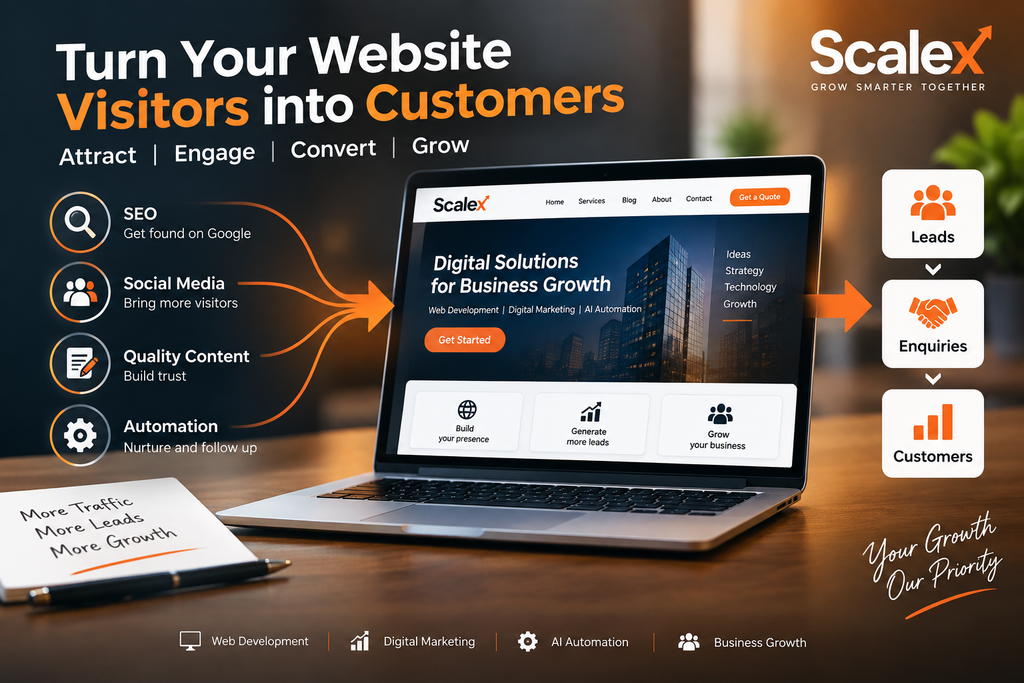
A lead is a person or business that has shown interest in your products or services and may become a customer. Website lead generation is the process of attracting relevant visitors to your website and encouraging them to take a useful action.
Depending on the business, a lead-generation action could be submitting a contact form, requesting a quotation, booking an appointment, calling the business, starting a conversation, downloading a resource, or sending an enquiry.
Why Your Website May Not Be Generating Leads
A website can receive visitors and still generate very few enquiries. Common reasons include:
-
- Visitors cannot quickly understand what the business offers.
-
- The website does not clearly communicate who the service is for.
-
- There is no obvious call-to-action.
-
- Contact forms are difficult or too long.
-
- Important service information is difficult to find.
-
- The website does not build enough trust.
-
- The mobile experience is poor.
-
- Pages load slowly or feel difficult to use.
-
- The website receives little relevant search traffic.
-
- Leads are collected but are not followed up consistently.
10 Ways to Generate More Leads from Your Business Website
1. Clearly Explain What Your Business Does
A visitor should be able to understand your business quickly. Your homepage should clearly communicate what you offer, who you help, and the main value you provide. Avoid vague statements and use simple, customer-focused language.
2. Create a Strong Homepage
Your homepage should guide visitors through the most important information. A useful structure can include a clear headline, short introduction, key services, benefits, trust signals, relevant proof, and a strong call-to-action.
3. Use Clear Calls-to-Action
A call-to-action tells visitors what to do next. Examples include Contact Us, Request a Quote, Book a Consultation, Get Started, or Talk to Our Team. Use calls-to-action at logical points throughout important pages.
4. Make It Easy to Contact You
Keep contact information easy to find. Use a simple contact form, make phone numbers easy to use on mobile devices, and provide a clear enquiry option where appropriate. Avoid asking for unnecessary information at the first stage.
5. Create Dedicated Service Pages
If your business provides several services, give each important service its own page. A dedicated service page can explain the problem, solution, benefits, process, FAQs, and next step in greater detail.
6. Add Trust Signals
Useful trust signals can include customer testimonials, case studies, reviews, certifications, experience, clear business information, and examples of previous work. Use genuine evidence and avoid exaggerated claims.
7. Optimise Your Website for Search
SEO can help relevant people discover your website when they search for products, services, or information related to your business. Create useful pages around real customer needs, use clear titles and headings, write helpful content, and build relevant internal links. For more guidance, read Google’s official SEO Starter Guide to understand how search engines discover and understand website content.
8. Create Helpful Blog Content
Blog content can attract people who are researching a problem before they are ready to contact a business. Helpful articles can answer questions, explain options, compare solutions, and demonstrate practical knowledge.
9. Make Your Website Mobile-Friendly
Many visitors access websites from smartphones. Use readable text sizes, make buttons easy to tap, keep forms simple, avoid intrusive elements, and check that navigation and contact functions work correctly on mobile.
10. Connect Your Website With Marketing and Automation
A website can be connected with digital marketing channels, customer relationship tools, forms, email, analytics, and AI-powered automation. For example, an enquiry can be acknowledged automatically and routed to the appropriate person for follow-up.
Use Your Website Together With Google Business Profile
For businesses serving local customers, Google Business Profile can help people discover the business through Google Search and Google Maps. The website then provides a place where interested visitors can learn more about the business and take a further action.
This creates a natural journey: a customer discovers the business through Google, visits the website, understands the service, and submits an enquiry or contacts the business.
Our related guide, “How to Create a Google Business Profile: A Complete Guide for Local Businesses,” explains how businesses can set up and optimise their profile.
Use Social Media to Bring Visitors to Your Website
Social media can help businesses build awareness, engage with customers, and distribute useful content. When appropriate, social posts can direct interested people to a relevant website page instead of sending everyone only to the homepage.
For example, a Facebook post about a service can link directly to the corresponding service page, while an educational post can link to a detailed blog article.
Our related guide, “How to Create a Facebook Page for Your Business: A Step-by-Step Guide,” explains how businesses can establish a professional Facebook presence.
Website + SEO + Social Media + AI Automation
-
- SEO can help relevant people discover your content.
-
- Google Business Profile can support local discovery.
-
- Social media can build awareness and send interested visitors to your website.
-
- A professional website can explain your services and convert visitors into enquiries.
-
- AI automation can help organise and follow up on enquiries and repetitive tasks.
The right combination depends on the business, audience, goals, budget, and available resources.
How to Measure Website Lead Generation
Before making improvements, decide what counts as a lead for your business. Then monitor useful actions and outcomes.
-
- Contact form submissions
-
- Phone calls
-
- Enquiry emails
-
- Appointment or consultation requests
-
- Quotation requests
-
- Relevant landing-page conversions
-
- Leads generated from specific campaigns
Traffic is useful, but traffic alone is not the final business objective. A smaller number of relevant visitors who become genuine enquiries can be more valuable than a large amount of untargeted traffic.
Common Website Lead-Generation Mistakes to Avoid
-
- Making the website look attractive but failing to explain the offer clearly.
-
- Using too many calls-to-action that compete with each other.
-
- Making visitors complete unnecessarily long forms.
-
- Hiding contact information.
-
- Ignoring mobile users.
-
- Publishing content without understanding customer search intent.
-
- Sending every marketing campaign to the homepage.
-
- Failing to follow up with new enquiries.
-
- Expecting SEO or social media to produce immediate results.
-
- Using AI-generated content without reviewing its accuracy, usefulness, and relevance.
How Scalex Can Help
Scalex helps businesses build and improve their digital presence through Digital Marketing, Website Development, AI Business Automation, and AI Consulting & Training.
-
- Business website development
-
- Website improvement and optimisation
-
- Service-page and landing-page development
-
- SEO-focused content planning
-
- Digital marketing strategy
-
- Lead-generation optimisation
-
- Contact and enquiry workflow improvements
-
- AI-powered business automation
-
- Ongoing digital growth support
Our digital marketing and website improvement services help businesses generate more leads by improving visibility, user experience, and conversion opportunities.
The objective is not simply to bring more visitors to a website. The goal is to attract the right visitors, give them a clear reason to take action, and create a practical process for handling the enquiries that follow.
Conclusion
A business website can be much more than an online brochure. With clear messaging, useful service pages, strong calls-to-action, trust signals, mobile-friendly design, search-focused content, and an effective follow-up process, it can become an important part of a business’s lead-generation system.
In 2026, businesses also have opportunities to connect their websites with social media, Google Business Profile, digital marketing tools, and AI-powered automation. The best approach is to build a system around real customer needs and measurable business goals.
Frequently Asked Questions
How can I generate leads from my business website?
Start with clear messaging, useful service pages, strong calls-to-action, simple contact options, trust signals, relevant SEO content, and a reliable follow-up process.
Why is my website getting visitors but no enquiries?
Possible reasons include unclear messaging, weak calls-to-action, poor user experience, lack of trust signals, irrelevant traffic, difficult contact forms, or weak follow-up.
How many contact forms should a website have?
There is no single ideal number. Place a simple enquiry option at logical points where visitors may be ready to take action, while avoiding unnecessary repetition.
Does SEO help generate leads?
SEO can help attract relevant visitors from search engines. To generate leads, the destination page also needs to satisfy the visitor’s intent and make the next action easy.
Can social media generate website leads?
Yes. Social media can help build awareness and direct interested users to relevant service pages, landing pages, articles, or enquiry forms.
Can AI help with website lead generation?
Yes. AI and automation can support tasks such as enquiry routing, acknowledgement messages, lead qualification, data organisation, and follow-up workflows.
Pingback: AI Automation for Small Businesses: 7 Practical Tasks